

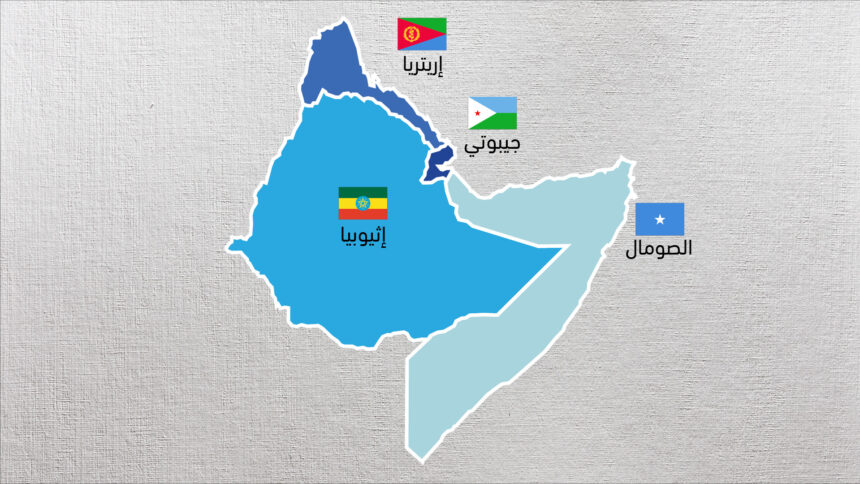
In a remarkable geopolitical development, a new strategic corridor is quietly being formed linking India and Europe, passing through the Horn of Africa, bypassing Yemen and the Bab al-Mandab Strait, in a step that reflects profound shifts in the balance of regional and international influence.
According to Israeli newspapers, this path is known as: “The Indo-African-European Corridor” (IAEC), as it extends from India through the Emirates, Somaliland and Ethiopia, all the way to Europe, which gives it increasing geopolitical and economic importance, especially in light of the ongoing tensions in the Red Sea.
A strong impetus for this project came after the signing of a mutual recognition agreement between Israel and Somaliland.
Observers believe that this development provides, for the first time, official political cover for a strategic axis linking India to the Gulf states, the Horn of Africa, and the Mediterranean, with a pivotal role for both Somaliland and Ethiopia in bypassing traditional maritime choke points, most notably Yemen.
According to political estimates, the new corridor may extend in the future from India to the UAE, then to Somaliland and Ethiopia, and from there through Sudan to the Libyan port of Benghazi, all the way to Europe, depending on the political and security arrangements in the region.
The United Arab Emirates plays a prominent role in this path through its management of parts of the port of Berbera in Somaliland, and its operation of regular shipping lines, in addition to its support to enable Ethiopia to access the sea. Abu Dhabi also contributes to multiple regional files, including Sudan, Yemen, and Syria.
On the other hand, there is a difference in regional positions, as the UAE and Syria did not join the statement condemning Israel after its recognition of Somaliland, unlike 21 other countries in Africa and the Middle East.
Western reports, including the British newspaper The Guardian, indicate that international recognition of Somaliland may witness a gradual expansion, especially with the growing political and economic role of the region, and the possibility that countries such as India, Ethiopia, and the UAE will follow Israel’s example in this direction.
Italy has also revitalized its presence in the Horn of Africa, benefiting from its historical relations with Libya and Ethiopia, amid talk about the possibility of establishing a trade bridge linking the port of Benghazi with Europe, which would contribute to supporting economic stability and reducing irregular migration flows.
Observers believe that the Indian-African-European corridor may constitute, in the coming years, one of the most important global trade routes if the appropriate political and security environment is available to it, redrawing the map of economic influence between Asia, Africa and Europe.