

Written by: Shaima Hassan Ali
It seems that the Libyan disputes did not end with the end of last year, but rather they extended until they reached the judicial authority, between steps and decisions approved by the House of Representatives in the East, and sharp criticism of these measures in the West, by the Supreme Council of State, the government, and the Supreme Court itself.
The dispute is mainly due to the House of Representatives' attempts to establish a new constitutional court, an attempt that some considered a step in the path of perpetuating political division to affect the judiciary, which has remained unified since the fall of Gaddafi's regime.
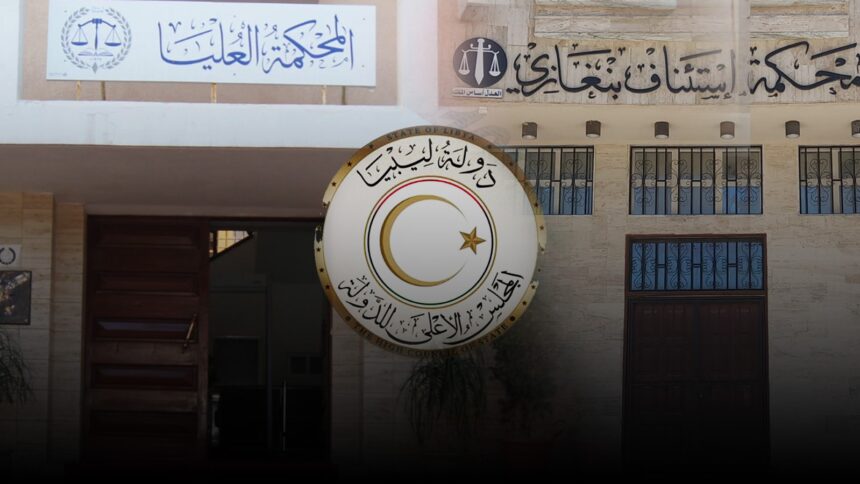
In a move that the Supreme Council of State considered an infringement on the judicial authority, the latter issued a statement in support of the Supreme Court and the Constitutional Chamber in Tripoli, which was supported by the Government of National Accord through its latest statement. These moves came after the House of Representatives in Benghazi announced the issuance of a law to establish a Supreme Constitutional Court, appoint its judges, and open its headquarters in Benghazi.
In fact, according to specialists, this step constitutes a link in the chain of perpetuating the political division between East and West.
The importance of the constitutional judiciary and the actions of the House of Representatives
The constitutional judiciary is considered the basic guarantee of the sovereignty of the constitution and the protection of rights and freedoms, as it monitors laws to ensure their compliance with constitutional texts and prevents any authority from exceeding its limits. It also establishes the rule of law and the principles of democratic governance by protecting the electoral process and political rights.
The most important tasks of the constitutional judiciary include: interpreting constitutional texts, achieving a balance between powers, protecting rights and freedoms, and imposing oversight on the constitutionality of laws.
The most prominent challenges that the constitutional judiciary can face are its politicization or the establishment of competing constitutional courts that affect stability, which is the situation that Libya suffers from after the fall of the Gaddafi regime.
The House of Representatives justified its position by considering that the establishment of a constitutional court does not constitute a violation of the principle of separation of powers, but rather aims to create an independent body responsible for monitoring the constitutionality of laws. He stressed that this role does not represent interference in the work of the judiciary, and that oversight will contribute to regulating the performance of democratic institutions, preserving the unity of the legal system, and preserving freedoms.
The constitutional judiciary, according to generally accepted standards, is established through the constituent power “the Constitution,” and the government or the House of Representatives may not establish it unless the Constitution stipulates that. What happened in Libya was the establishment of a Supreme Constitutional Court in Benghazi despite the presence of the Constitutional Chamber in Tripoli, which shows the incursion of the legislative authority into the unified judicial authority and the perpetuation of division.
The problem related to the judicial authority
In this context, we posed some questions to the specialist in Libyan affairs, Osama Al-Shahoumi, to explain what is happening on the Libyan scene:
How do you evaluate the dispute between the House of Representatives and the Supreme Council of State over the Supreme Court and the Constitutional Court?
Al-Shahoumi believes that the dispute is not technical or legal, but rather a structural crisis that affects the essence of the Libyan state, because it has moved from the level of political disagreement to dismantling the judicial authority itself.
Formally, the House of Representatives presents its position as an exercise of its legislative powers to establish a new constitutional court in Benghazi, while the Supreme Council of State sees this measure as an infringement of the Constitutional Declaration and a violation of the principle of separation of powers, especially in light of the absence of national consensus.
In fact, there are two courts: the Supreme Court and the Constitutional Chamber in Tripoli, and a Constitutional Court in Benghazi that was established by the House of Representatives last April, which leads to two conflicting judicial legitimacy, which is the most dangerous thing a country like Libya can reach.
To what extent does this crisis affect the international path to a political solution?
According to Al-Shahoumi, this situation is devastating to the international path, because it undermines the idea of the constitutional rule. Any international process requires a single judicial body to decide on the constitutionality of laws and electoral appeals, and with the presence of two courts there are no guarantees for any political or electoral entitlement, which practically leads to the disruption of the elections.
Does the division reflect a struggle over legitimacy or political influence?
The division is a struggle for influence wrapped in the discourse of legitimacy, as each party uses legitimacy as a weapon: Parliament has old electoral legitimacy, and the Supreme Council of State has consensual legitimacy through the 2015 Skhirat Agreement. Controlling the Constitutional Court means controlling legitimacy itself.
Evaluation of the proposed international committee
Although the idea aims to preserve the constitutional judiciary, Al-Shahoumi believes that the proposed committee has no binding tools, no executive authority, and no mechanism to impose penalties on obstructionists, and therefore it can be considered a “failure.” The accumulation of international initiatives without results also gives the parties to the conflict time to continue the division, which makes the committee merely a relay of the crisis and not a solution to it.
The recent moves of the House of Representatives show an attempt to legitimize a parallel situation of power in Tripoli, through the establishment of political, legislative, military and judicial structures in the Libyan east, while the internationally recognized government exists in the west. All of this is happening in light of economic crises afflicting the Libyan citizen, amid popular demands for unified elections, while the reality is very far from achieving stability.