

Written by Shaima Hassan Ali
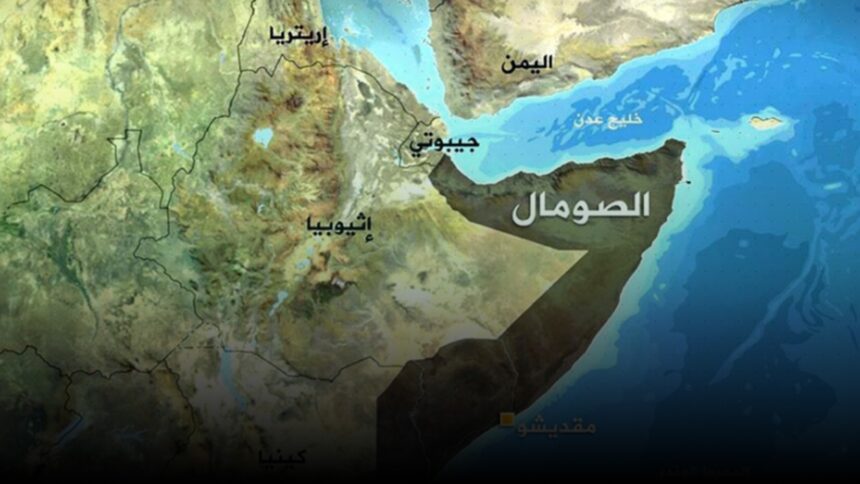
Israel recognized Somaliland in late September 2025, which was considered by political, media and popular circles as a political earthquake that could ravage the Horn of Africa region. It goes without saying that this strategically located region is rife with political, economic and social crises, not the least of which are ethnic conflicts and secessionist tendencies spreading in the countries of the Horn of Africa. Also, the different peoples and communities in the Horn of Africa tend to become independent from the post-colonial African entity or state, due to the state’s failure to integrate the various social components, create a comprehensive national identity, enforce the law, and achieve a peaceful transfer of power.
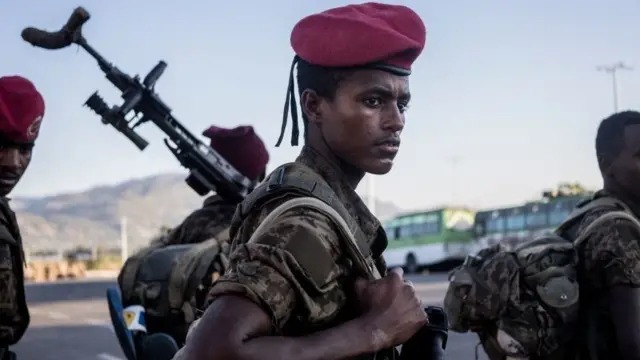
On this basis, the separatist tendency appears unbridled in the countries of the Horn of Africa, and this trend was encouraged by what happened in the secession of South Sudan from Greater Sudan and the international recognition of the state of the South.
Even if the international circumstances supporting the latter are different, the same idea exists and is being implemented, with the separation being legitimized with the support of influential regional powers. Accordingly, the fragmentation of countries into fragile entities can be achieved by the domino theory, which means in its entirety that the occurrence of a certain phenomenon in one country may lead to its spread in other countries, which is what the countries of the Horn of Africa fear, and encourages entities with separatist tendencies to take the same step.
Hence the following question arises: Can the Tigray Liberation Front recognize Somaliland, despite the Ethiopian position of cooperation with Herehesia, and Addis Ababa’s lack of objection to the Israeli approach to behavior? This analysis discusses the dilemma that the TPLF could fall into as follows
First, the civil war in the Tigray region 2020 2022
The war broke out in the Tigray region and continued for two years between the Ethiopian government and the Tigray Liberation Front, following the disintegration of the ruling coalition that was controlled by the Front, and the start of Abiy Ahmed’s regime to carry out broad reforms, in addition to the Tigray region’s feeling of marginalization, and the postponement of the elections that were scheduled to be held under the pretext of the outbreak of the Corona epidemic. On the other hand, the regional government quickly organized elections in November 2020. Finally, this path ended with the outbreak of the civil war that lasted for two years.
During this period, Ethiopia rearranged its regional and internal alliances, so that Eritrea, yesterday's enemy, became today's ally. In any case, this conflict ended with the signing of the Pretoria Agreement in South Africa in the city of Pretoria on November 2, 2022, with the support of the African Union and the guarantee of the United States of America. Despite the fragile state of calm, matters have become more complicated, especially in light of Abiy Ahmed’s behavior, which was characterized by evading the implementation of the most important provisions, which makes the possibilities of renewed conflict strong.
Secondly, Abiy Ahmed’s policies towards the Tigray Liberation Front
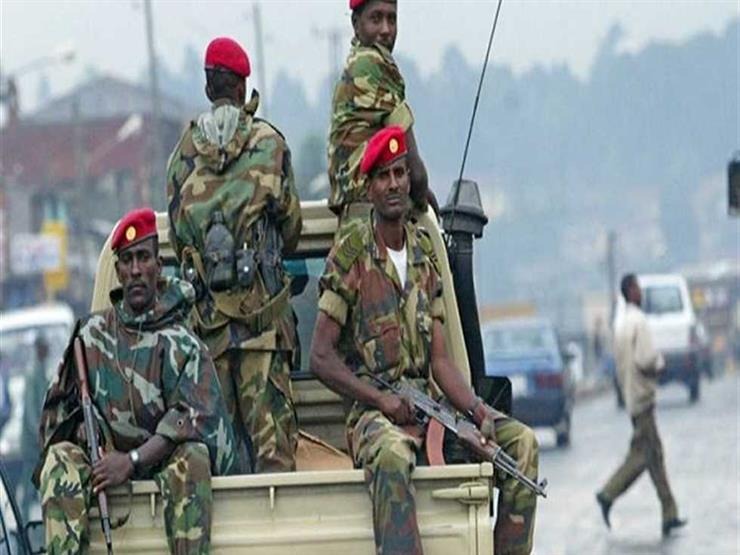
Abiy Ahmed sought to sow discord within the leadership ranks of the Tigray Liberation Front and attract a number of its leaders. He also took practical steps that increased the ambiguity of the Front’s status, including canceling its legal status in May 2025. In return, the Front did not commit to handing over weapons or integrating into the ranks of the Ethiopian army. In addition to this, the Ethiopian forces and their allied forces continue to control lands in southern and western Tigray, in addition to the limited entry of humanitarian aid, and the non-return of the displaced, whose number is estimated at about 600,000 displaced persons and refugees.
The division within the front also worsened between two wings, the Getachew Reda wing and the Debretsion Gebremichael wing. In addition to this, there is the extreme slowness in implementing the transitional justice framework, with accusations of perpetuating a culture of impunity, as a result of the absence of strong international oversight mechanisms to hold perpetrators of violations accountable on all sides.
These developments have contributed to reshaping the already fragile map of alliances. By 2026, the most prominent transformations in the map of alliances can be summarized as follows: The relationship between the federal government and the Tigray Liberation Front transformed from an all-out war to political cooperation to manage the region through the interim administration led by Getachew Reda. On the other hand, a sharp division emerged within the front between two wings: the Getachew Reda wing, which tends toward calm and cooperation with Addis Ababa to implement the agreement and secure aid, and the Debretsion Gebremichael wing, which represents the old guard and adopts more radical positions toward the federal government. The differences between the two parties have reached the point of exchanging decisions of dismissal and membership cancellation during the years 2024 and 2025.
At the same time, the Amhara-Fano forces and militias considered that the Pretoria Agreement represented a betrayal of their interests, as it did not officially recognize the ownership of the disputed areas such as Welkit. As a result, the Fano forces turned from an ally of the federal army against Tigray to rebels against it, making the Amhara region a new battlefield from 2023 to 2026.
As for external alliances, after Eritrea was Addis Ababa's most prominent military ally against Tigray, relations between the two parties deteriorated significantly following the agreement. Some reports indicate the possibility of a rapprochement between the Front and Eritrea, and other reports even talk about an Eritrean rapprochement with the Fano militia, a former ally of Abiy Ahmed. The biggest dilemma remains the change in regional alliances, with signs of rapprochement emerging between the interim administration of Tigray and some regional and international powers.
Third, the position of the Tigray Liberation Front and recognition of Somaliland
From a pragmatic perspective, and according to interest calculations, the Tigray Liberation Front may seem closer to aligning with the Somaliland region, as both parties share the justifications and reasons for separating from the national entity. The Front actually believes in the right of peoples to self-determination, and on this basis it waged its struggle with the Abiy Ahmed regime. The position of the Tigray People's Liberation Front and the Ethiopian People's Revolutionary Democratic Front on Somaliland's right to sovereignty also has clear ideological roots.
However, recognition by regional powers of a secessionist region may open the appetite of other entities to follow the same path. The map of the Front's regional alliances places it in a camp that includes the Eritrean ally, those in solidarity with the Egyptian-Djibouti-Somali position, and the opposition to Abiy Ahmed's regime, an alliance that cannot be satisfied with such recognition. Therefore, the Front preferred to remain silent and not issue any supportive statements.
The dilemma that the Ethiopian state may face is the possibility of recognizing a separatist region, a scenario that may be repeated within the state itself if other regional powers grant recognition of the secession of the Tigray People's Liberation Front. Hence the danger of the Israeli move, which may contribute to destabilizing the entire Horn of Africa.
In sum, despite the ideological interests of the Tigray Liberation Front in supporting the move of the separatist region in Somaliland, and this being consistent with its belief in the right of peoples to self-determination, the calculations of the regional alliances that Michele relies on in confronting the Abiy Ahmed regime push her to remain silent.