

Shaima Hassan Ali
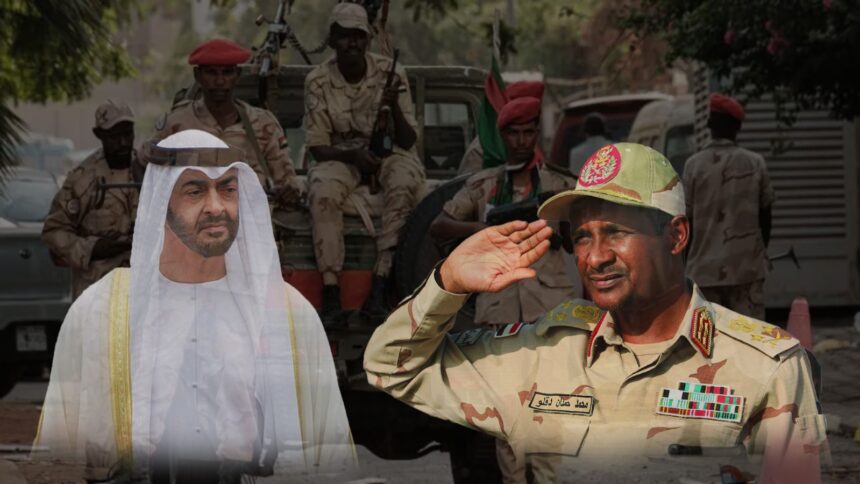
In the midst of the worsening crisis in the city of El Fasher, the withdrawal of the army forces and its military garrison, and the flight of more than a quarter of a million people after the Rapid Support took control of it, several UN and international reports described the situation in Sudan and revealed the supply of weapons and equipment used by the Rapid Support. The UAE was the main party that was described with the presence of regional cooperation from neighboring Sudanese countries, a support that the government in Port Sudan has long denounced. However, the latter has filed suits with the International Court of Justice to condemn the UAE for its position, and this is being discussed. The report revealed the methods of the UAE’s support for the Rapid Support Forces, as follows:
First: The nature of the weapons available since April 2023
Since the outbreak of the conflict between the army forces and the Rapid Support militias during the period (April-June 2023), nothing has been observed on the battlefields other than traditional weapons such as 12.7-caliber heavy machine guns, ZU23 anti-aircraft guns mounted on Land Cruisers, rocket-propelled grenades, mortars, BTR80 personnel carriers, and some small and light weapons.
Since August 2023, the Rapid Support has been able to obtain shipments of heavy weapons, drones, helicopters, howitzers, and anti-aircraft weapons as an alternative to air defense systems. Through this logistical supply, the militia has been able to change the balance of power, and has actually shot down some Sudanese Air Force aircraft. It has also been able to control the city of “Nyala” and “El Geneina.” The report of the UN experts on Sudan documented some of the main methods by which Arms shipments and medical support to rebel militia fighters.
“Um Djeres” airport in western Chad - where the Sudanese refugee camp is located - is considered a shipping and distribution destination for weapons that come through Emirati airports. Flights can also stop to refuel or for another purpose in African countries such as Kenya, Rwanda, Uganda, and via the “Bari or Carrier” road, after unloading the shipments into small convoys on trucks and arriving in West Darfur and from there to areas controlled by militias. The “Darfuri” movements, which have ties to the “Tebu” community component in Libya, also purchased fuel and passed it from southern “Libya” to “Darfur.” The matter was not limited to fuel, but extended to purchasing weapons and Land Cruisers and passed it through northern “Darfur.”
Some satellite images documented flights that departed from the Emirati airports “Abu Dhabi” and “Al Ain,” for flights to airports in the countries of “Libya,” “Chad,” “Central Africa,” and “South Sudan.” After these measures, the militias launched coordinated attacks on Khartoum, the island, and the main cities. They also announced the entry of “El Fasher,” in addition to preparing to take control of towns in “Kordofan.”
Second: Chinese weapons are in the hands of the Rapid Support
According to an Amnesty International report, Chinese GB50A guided bombs and 155 mm AH-4 howitzers were found after analyzing photos and videos, and that this type of weapons and bombs are manufactured by the Chinese company “Korenko”, and that this is the first time that the use of this type of weapons has been documented in a civil conflict, meaning that the UAE has contracted to purchase shipments of weapons and then send them back for rapid support in violation of the UN Security Council resolution. By imposing a ban on arms exports in Darfur, the organization even tried to communicate with the Chinese company, but they did not respond. It also contacted the UAE, but it denied these allegations.
Third: UAE disavowal under the guise of humanitarian and medical aid
According to the report submitted to the UN Security Council, through the team concerned with Sudanese affairs, the evidence indicating Emirati involvement was denied by the latter, as it claimed that the shipments that were unloaded in the refugee camps on the Chadian-Sudanese border were part of humanitarian and medical support shipments. These are the same allegations that the Emirati party and its media machine are still repeating behind them, despite the clear and documented evidence that proved its support for the militias that commit crimes against defenseless Sudanese.
Fourth: Rapid Support crimes since the fall of El Fasher
What the UN reports documented is “truly horrific,” as killings of up to 2,000 people were recorded in just two days. According to eyewitnesses, the attacking forces carried out systematic cleansing campaigns based on tribal identity, targeting the neighborhoods of Zaghawa, Al-Salam, and Al-Shamali, where houses were stormed house by house, and entire families were executed indiscriminately. Reports also documented cases of mass rape and sexual violence against women and girls, committed by members of the Rapid Support Forces alongside foreign fighters believed to have come from Chad, Mali, and Niger. Some local doctors reported that a large number of victims were executed at close range, while some bodies were transported to unknown places to hide evidence, while other bodies were left in the streets without burial, according to Dr. Abdel Nasser Hamed, senior researcher and director of the East Africa Program. And Sudan at the Fox Research Center (Sweden). The city of El Fasher is facing systematic mass executions targeting civilians and prisoners on the basis of identity and belonging. In order to cover up its crimes that spread on social media pages, the rebel militia deliberately cut off the “Starlink” service and public communications from the city, in a clear attempt to prevent the leakage of photos and videos documenting the ongoing executions and violations.
In conclusion, the Rapid Support was able, thanks to the support of the Emirates and other international and regional bodies, to modernize its weapons system, by acquiring fuel and quality weapons that made a difference in the balance of power, and also provided it with a comparative advantage in the presence of air defense through the Chinese Wang Yong drones and others, thus achieving field gains. Despite the UAE’s denial of these accusations and its justification that the shipments are “humanitarian aid,” the field evidence indicates the opposite, especially with the massacres documented by international reports. And war crimes after the fall of the city of El Fasher in October 2025, when the death toll exceeded 2,000 people within two days, and mass executions, sexual violence, and ethnic cleansing based on tribal identity were repeated.